






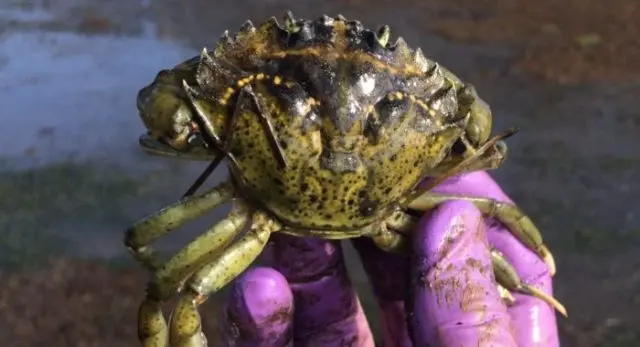
LONG BEACH — The pressure to find a solution to the European green crab invasion in western Washington appears to have amped up with the release of a new study.
Scientists at Washington State University have found that juvenile green crabs can do as much damage as adults to shellfish and native sea plants, calling into question current methods to eradicate the invasive crustaceans.
Green crabs are a massive threat to Washington state’s shellfish industry as well as its native eelgrass, a plant vital to local seawater ecology.
For several years, shellfish growers have been trapping mostly adult green crabs in huge numbers. More than a million were caught in Willapa Bay and Grays Harbor alone last year. But the new study shows that current removal techniques may not be enough.
They now know that juvenile crabs can crack into immature shellfish, such as oysters and Manila clams that are grown for humans to eat, just as easily as the larger-clawed adults, according to a paper recently published in NOAA Fishery Bulletin.
Washington state is the top producer of shellfish aquaculture in the country, with yearly production estimated in excess of $200 million.
In the study, the scientists also confirmed that the crabs arbitrarily are clipping the eelgrass, killing the plants for no known reason. Eelgrass is a habitat for lots of native species, especially juvenile salmon and other fish.
Researchers plan to work with groups around Willapa Bay and Grays Harbor, which both have huge green crab populations and important shellfish industries, to figure out how to fight adult and juvenile crabs.